
Your team logs into dozens of apps every day. Sales works in one CRM, support in another ticketing system, and finance in yet another ERP platform. Each department chooses the “best tool for the job,” but no one stops to ask what happens when those tools can’t communicate with each other. The answer is a fragmented enterprise that drains value in ways most organizations never measure.
The constant need to switch between disparate applications exacts a significant toll on productivity, wasting valuable time throughout the day. This digital friction compounds daily across every department, workflow, and customer interaction. Unifying fragmented systems is critical, and it offers numerous benefits that extend far beyond immediate cost savings.
This guide from DataMotion maps the hidden costs of enterprise fragmentation and the real returns of unifying your systems.
Enterprise fragmentation happens when different systems and applications across your organization operate in isolation from one another. Data lives in separate silos, and workflows stop at departmental boundaries. Information that should flow seamlessly instead requires manual intervention, duplicate entry, or custom integration work.
Understanding Tool Sprawl
Organizations are increasingly juggling a vast and ever-growing number of applications. A significant portion of these tools often operate in isolation, lacking seamless integration with one another. This fragmentation happens gradually as departments independently adopt software-as-a-service (SaaS) tools to address immediate operational needs without considering enterprise-wide implications.
This pattern manifests differently across target industries, for instance:
The problem compounds as organizations scale. What starts as a handful of specialized tools becomes dozens, then hundreds of disconnected applications that create data silos across every business function.
Compounding Costs of a Disconnected Enterprise
We’ve established what enterprise fragmentation is and how it occurs organically through growth. Now let’s examine the financial reality of operating this way. Think of fragmentation as a tax on every business process. Unlike a one-time expense, this tax compounds daily and worsens as your application portfolio expands.
When systems are disconnected, employees spend significant time searching for information rather than using it productively. Constant hunting for data across various platforms diverts focus from critical tasks and hinders effective decision-making. A lack of cohesive digital organization frequently impedes employees’ ability to work efficiently.
The mental burden of constantly switching between numerous applications to complete routine tasks can drastically reduce an individual’s productive time. Consider a common scenario where an employee might:
This workflow fragmentation directly impacts how quickly teams can execute. Data silos also prevent effective collaboration. When sales, marketing, and customer success teams work in separate systems, no one has a complete view of the customer journey. Critical information remains locked in departmental databases while teams make decisions based on incomplete data.
Increased Operational and IT Overhead
The financial costs of fragmentation extend far beyond productivity losses:
Enterprise fragmentation carries substantial and often unmeasured consequences. These hidden costs impact various facets of an organization, from security and compliance to employee and customer experience. Understanding these costs is crucial for justifying investments in unifying systems.
Security and Data Exposure
When data is scattered across hundreds of systems, securing that information becomes exponentially more difficult. Monitoring access controls, tracking data flows, and maintaining consistent security policies across a fragmented landscape stretches security teams beyond their capacity.
The risks compound in specific ways that create vulnerabilities most organizations don’t recognize until a breach occurs:
The mean cost of a data breach in 2024 was around $4.4 million, according to IBM, and the average company spent 241 days to identify and contain the breach. The reputational damage and erosion of customer trust often exceed the immediate financial penalties.
Compliance Processes
Proving compliance becomes a challenge when data lives across dozens or hundreds of disconnected systems. Regulations and standards like GDPR, HIPAA, FINRA, and PCI-DSS require organizations to demonstrate complete control over data flows, access controls, and audit trails. Fragmented systems make this demonstration nearly impossible without significant manual effort.
Manual compliance processes in fragmented environments also create substantial hidden costs. Consolidating reports for regulators becomes a time-consuming, error-prone exercise when each system maintains its own logs and records. Teams spend weeks preparing for audits by manually gathering evidence from disconnected sources and reconciling inconsistencies between systems.
Conflicting data across systems can lead to regulatory noncompliance, resulting in heavy fines, legal issues, and severe reputation damage.
Employee Engagement and Experience
Enterprise fragmentation can create daily frustration, impacting employee satisfaction and engagement. Workers may log into multiple incompatible platforms to complete simple tasks. The resulting app fatigue and workflow interruptions can contribute to increased stress.
When departments operate in separate systems, information silos can prevent employees from understanding how their work connects to broader organizational goals. For example, sales teams may be unable to see the marketing campaign’s performance, or customer support may lack visibility into product development priorities.
This disconnection leads to inconsistent employee experiences, communication gaps, and disengagement. To put it in perspective, in 2024, Gallup estimated that employee disengagement cost the global economy $434 billion.
Customer Journeys and Trust
Internal fragmentation inevitably manifests in customer-facing interactions. When your systems don’t communicate, customers experience the consequences directly. They may receive inconsistent service depending on which department they contact, or they might have to navigate disconnected portals and interfaces for different interactions with your organization.
U.S. companies risk losing $846 billion due to poor client experiences, and 51% of customers reduce or stop spending completely after a negative experience, according to research. Customers expect seamless interactions where your organization remembers their preferences, understands their history and provides consistent service regardless of channel. Fragmented systems make delivering this experience impossible.
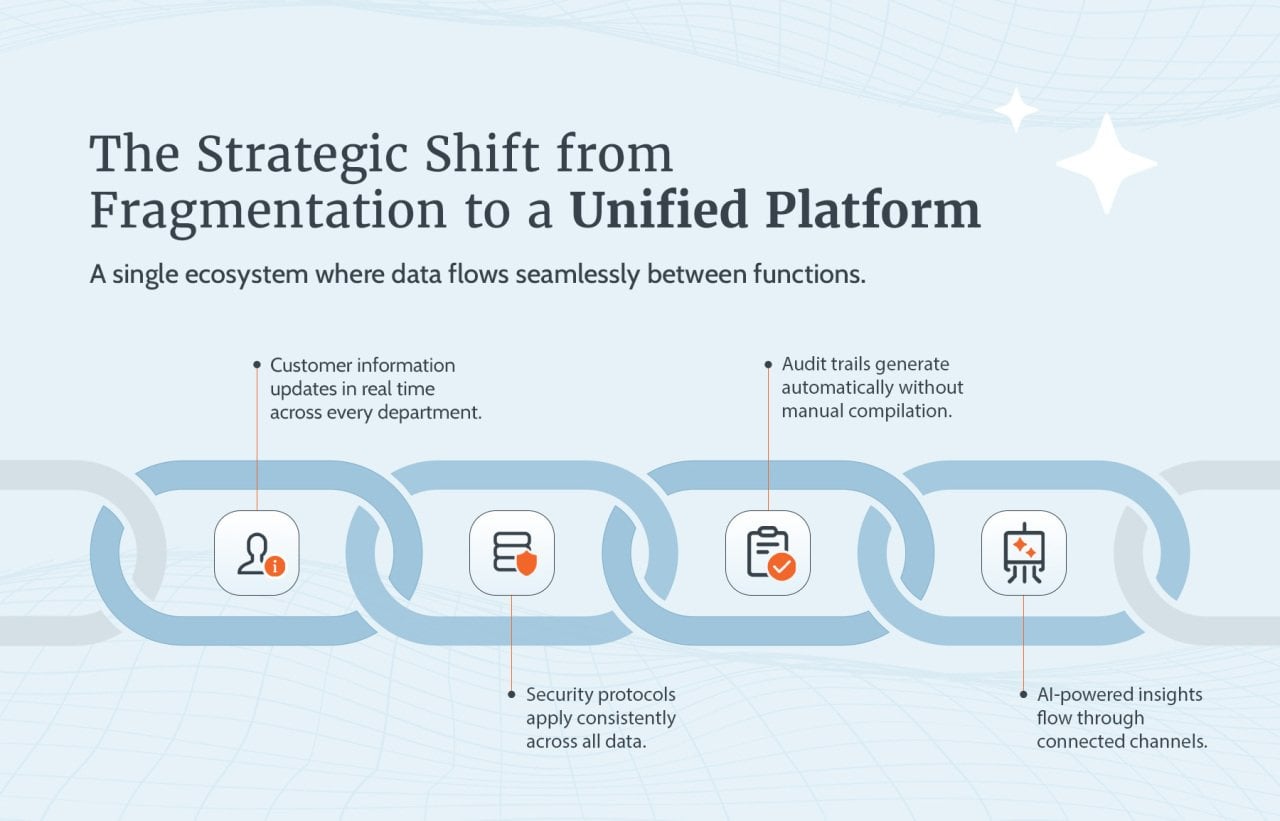
A unified platform consolidates fragmented tools into a single ecosystem where data flows seamlessly between functions. Imagine a single interface where employees access all necessary tools, including:
This vision contrasts sharply with the fragmented reality most organizations accept. Disconnected systems might have been “good enough” when digital transformation was optional, and customer expectations were lower. Those conditions no longer exist.
The demands of modern business, the opportunities created by AI, and the expectations of digitally native customers have turned fragmentation into a significant competitive disadvantage.
Organizations pursuing digital transformation hit immediate walls with fragmented data exchange. For instance, AI initiatives require clean, accessible data from across the enterprise, while customer experience improvements need unified views of interactions across all touchpoints. In the same breath, compliance automation depends on consolidated audit trails. McKinsey research suggests that successful organizations treat unified platforms as foundational requirements, not future aspirations.
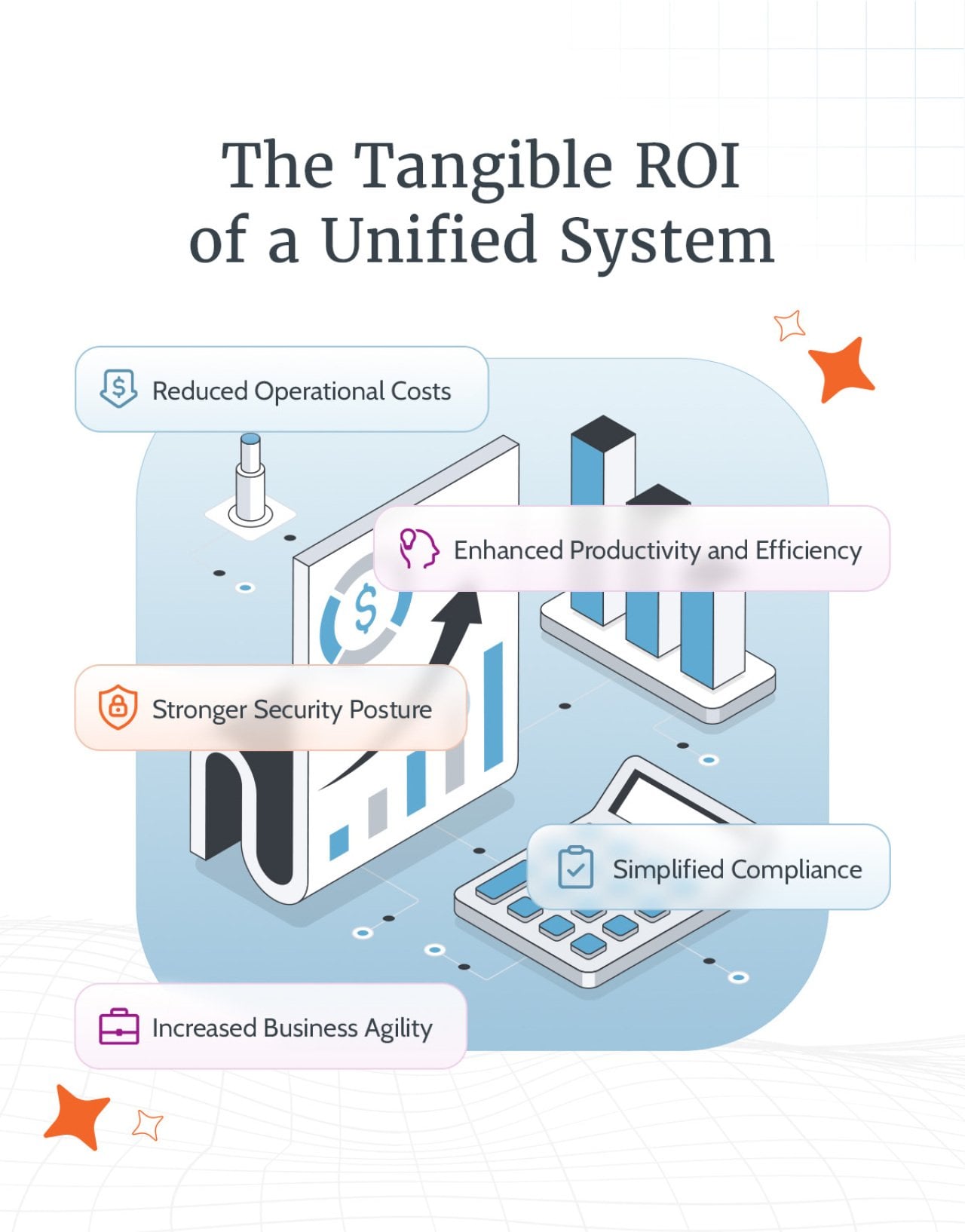
The strategic case for unification is clear, but decisions require numbers. Let’s consider the ROI that a unified platform delivers value across multiple dimensions.
Reduced Operational Costs
The most immediate financial returns come from eliminating redundant spending and inefficient processes. Consolidated platforms replace dozens of solutions, cutting software licensing spending and demonstrating how unification reduces operational costs.
Unified systems eliminate the massive ongoing expense of building and maintaining custom integrations between disconnected applications, allowing IT teams to reclaim resources previously consumed by integration maintenance. They can allocate these resources to strategic initiatives that drive competitive advantage rather than simply keeping existing systems functional.
Operational overhead drops when employees stop wasting time searching for information across disconnected systems.
Enhanced Productivity and Efficiency
Providing a single source of truth fundamentally changes how quickly organizations can operate. Employees access complete, consistent information without having to hunt across multiple platforms. Decision-makers see real-time data instead of waiting for manual reports that consolidate information from disconnected systems.
In the same breath, context-switching costs disappear when workflows occur within integrated environments. An employee completing a complex task no longer has to jump between a dozen applications. Unified platforms maintain workflow context, preserve relevant data, and guide users through connected processes without forcing constant mental reorientation. By enabling workflow automation across previously disconnected functions, these platforms allow organizations to handle higher volumes with the same headcount.
Stronger Security Posture
A unified platform consolidates your attack surface by reducing the number of distinct systems that require independent security measures. Centralized security controls apply consistently across all data and communications rather than varying by application.
Unified visibility transforms threat detection and incident response. It allows security teams to monitor activity across the entire platform from a central point, making suspicious patterns immediately visible. When security events occur, investigation and remediation happen faster because relevant information lives in connected systems rather than isolated silos.
Simplified Compliance
Unified audit trails transform compliance from a recurring stressor into a manageable, proactive process. By consolidating all relevant activities into connected systems, generating comprehensive compliance reports becomes a straightforward query operation, eliminating the need for manual data gathering across disconnected platforms. This unification offers several tangible benefits:
Increased Business Agility
Leaders with access to unified, real-time data can make faster, more informed decisions. The ability to respond quickly to market shifts, customer needs, and competitive threats creates a competitive advantage that compounds over time.
Data-driven organizations can achieve superior business outcomes across revenue growth, customer retention, and operational efficiency. Unification makes the data-driven approach feasible by providing the integrated information required for analytical decision-making.
The strategic value of unification extends beyond short-term operational effectiveness to long-term competitive positioning and future capability development.
Building the Foundation for Responsible AI and Innovation
Artificial intelligence requires clean, accessible, and governed data. Fragmented environments make effective AI deployment nearly impossible since models trained on incomplete or inconsistent data produce unreliable results. Unified platforms with governed data create the essential foundation for leveraging AI and other next-generation technologies.
The data integration, quality controls, and access governance that unified systems provide become prerequisites for responsible AI deployment. Plus, Dell research found that organizations with unified data foundations deploy AI faster and more effectively than competitors still struggling with fragmentation.
Establishing a Sustainable Competitive Advantage
An organization that operates with higher productivity, stronger security, simpler compliance, and faster innovation builds competitive advantages that compound over time. The productivity advantage alone creates separation. Your unified teams deliver faster results with fewer resources because they’re not fighting with disconnected tools. This efficiency gap widens as competitors continue to bleed time and money due to fragmentation, while you reinvest those resources into innovation and growth.
Data strategy matters now more than ever as a primary driver of competitive advantage, given the exponential growth in data volumes and complexity. The winners will be organizations that unify their data and extract strategic value from integrated information.
Unlocking the Full Value of Enterprise Unification
Fragmentation creates massive hidden costs across your enterprise. From daily employee friction to invisible security vulnerabilities, these compounding losses threaten both immediate operations and long-term competitive positioning. The reverse is equally true. Unification delivers multifaceted ROI that compounds in your favor. Organizations that act now gain ground that their competitors can’t recover, including stronger security, simplified compliance, and accelerated innovation.
If you want to eliminate enterprise fragmentation, look for solutions that unify secure messaging, document exchange, forms processing, and AI-driven insights into a single platform. It’s also better to settle for tools specifically built for your industry, whether that’s financial services, healthcare, or the public sector. The best platforms deploy in days, not months, and strengthen data security with military-grade encryption and a zero-trust architecture while ensuring full compliance with industry regulations.
Finally, choose a platform that integrates seamlessly with your existing systems, eliminating the need for multiple fragmented point solutions. Organizations using a robust unification platform reduce IT overhead, accelerate digital transformation, and deliver seamless experiences across every customer and employee touch point.
This story was produced by DataMotion and reviewed and distributed by Stacker.



